
For thirty-two years I kept a paper notebook within arm's reach. Margin scribbles, reading notes, volunteer lists, the whole scattered archive of a working librarian's brain. When the Kindle Scribe arrived in May, I expected to hate it. I expected the screen to feel like glass, the pen to slide like a wet bar of soap, and the whole experiment to end with me back at the stationery store. Instead, I spent a month reading history with the Scribe propped on the kitchen table, writing in the margins the way I used to write in the margins of library copies, and I have opinions.
The short answer: the Amazon Kindle Scribe can replace a paper notebook for reading notes, but it is not a notebook replacement for everything. It is a large e-ink reader that happens to take handwriting well, and once you understand that, the choice gets simpler. If you take notes while you read, the Scribe is the closest thing I have found to the margin scribble. If you sketch, doodle, or need a notebook that works in the rain, keep the paper.
| Kindle Scribe | Paper Notebook | |
|---|---|---|
| Reading experience | 10.2-inch e-ink screen, comfortable for long reading sessions | No backlight, needs a lamp, but never glares |
| Note-taking while reading | Handwritten sticky notes in the margins of Kindle books, plus a separate notebook | Write directly on the page, but only in books you own and are willing to mark |
| Search and organization | Searchable handwriting, notebooks organized by title, easy to revisit | Flip through pages, hope you remember where you wrote it |
| Battery and upkeep | Battery lasts weeks, no ink to buy, no pages to tear | Always ready, but you run out of pages and pens |
| Feel of writing | E-ink with the Premium Pen, close to paper but not identical | Real paper, real pen, the feel most note-takers grew up with |
| Sketching and doodling | Works for simple diagrams, not for serious drawing | Unlimited medium, no lag, no screen to scratch |
| Durability and worry | Heavier, not waterproof, an expensive thing to drop | Easy to replace, survives coffee rings and rain |
| Best for | Readers who take notes while they read and want them searchable | Sketchers, journalers, and anyone who loves the feel of ink on paper |
Where the Kindle Scribe Wins
The Scribe wins the moment you want to find something you wrote. In a paper notebook, my reading notes lived in a dozen different volumes, and finding a thought about, say, the Roman aqueducts meant flipping through pages of handwriting. On the Scribe, I write a sticky note in the margin of a book, and later I can search my handwriting and jump straight back to the page. For a retired librarian who spent a career organizing information, that is not a small thing. It is the whole thing.
It also wins on comfort. The 10.2-inch e-ink screen is easier on my eyes at night than the bright backlit screen of a tablet, and the large page means I can read a history book without constantly turning pages. I read one nonfiction book a month on the Scribe, mostly history and biography, and I write notes in the margins the way I used to. The battery lasts weeks, there is no ink to buy, and the whole notebook collection lives in one device. That is the trade I was hoping for.
Here is a specific example from early June. I was about halfway through a long biography of John Adams, and I kept wanting to argue with the author's characterization of Abigail Adams. In a paper notebook, I would have written 'check this against the 1780 letters' on a page somewhere and lost it. On the Scribe, I wrote that note in the margin, attached to the exact page, and two weeks later I tapped the note and was back on that page in seconds. The search box found the phrase '1780 letters' even though my handwriting is not neat. That moment, more than any spec sheet, is why the Scribe stays on my kitchen table.
I also like that the Scribe keeps my volunteer notes separate from my reading notes. For the Friends of the Library group, I keep a running list of donated books that need pricing, and it lives in its own notebook on the Scribe. I used to keep that list on a yellow legal pad that migrated around the kitchen counter. Now it is always in the same place, and I can search it by donor name or by title. That is the kind of small, boring win that makes a tool worth keeping.
The Scribe is not a bedtime reader for me. I use my Paperwhite in bed because the Scribe is a two-hand or lap device and I do not want to hold it up in the dark. Instead, I read the Scribe at the kitchen table in the afternoon, with a cup of tea, and I take my time. That is a different reading posture, and it is worth knowing before you buy. If you want a device that does both, the Scribe's size works against it in bed.
The other thing that surprised me is how the Scribe handles a long book. I finished that John Adams biography over about three weeks, and my margin notes accumulated page by page. In paper, that many notes would have filled several pages of a separate notebook, and I would have had to keep the book and the notebook together. On the Scribe, the notes stay inside the book. When I reached the end, I could scroll through every note I had made without flipping a single page. That is not a small convenience. It changes how I read.
Where the Paper Notebook Wins
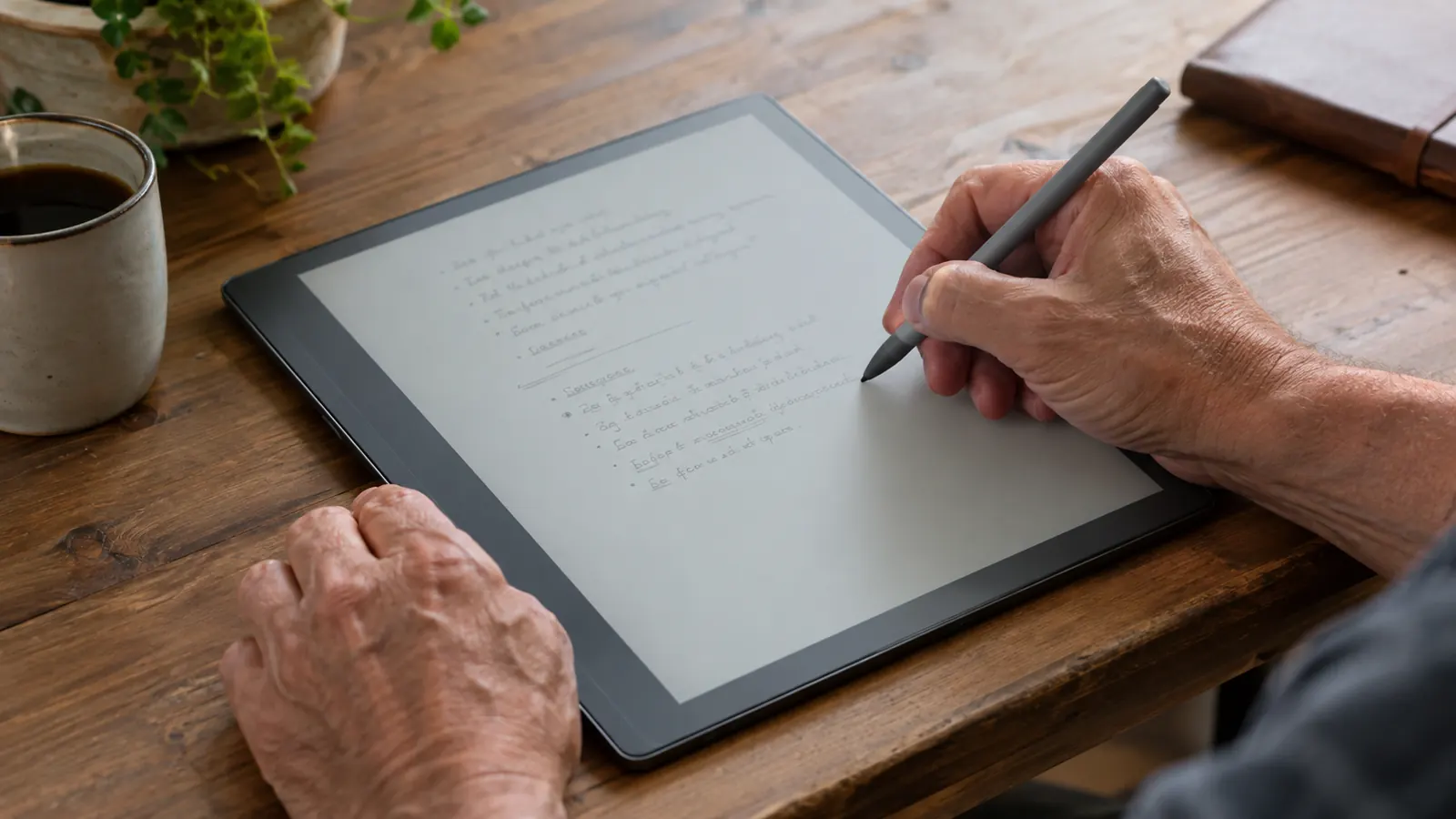
The paper notebook wins on feel, and I will not pretend otherwise. The Premium Pen on the Scribe's e-ink screen is remarkably close to paper, but it is not paper. There is a faint slickness, a tiny delay, a sense that the pen is writing on glass rather than fiber. For a quick margin note, I do not notice. For a page of journaling or a sketch, I notice. If your notebook is mostly for drawing, doodling, or the physical pleasure of ink on paper, the Scribe will not replace it.
Paper also wins on worry. The Scribe is heavier than my Paperwhite, a two-hand or lap device, and it is not waterproof. I would not take it to the porch in a summer storm, and I would not balance it on the arm of a chair the way I balance a notebook. A paper notebook survives coffee rings, rain, and the occasional drop. The Scribe is an expensive thing to drop. If your notebook goes everywhere with you, including places where it might get wet or knocked around, paper is the more sensible companion.
I tested this in a small way one afternoon in July. I sat at the kitchen table with a paper notebook and the Scribe, and I deliberately wrote the same list in both: groceries, a book to request from the library, a phone call to return. On paper, I finished in about a minute and the page felt done. On the Scribe, I needed to open the notebook, tap the pen icon, choose a pen style, and then write. It took longer, and I kept glancing at the screen to see whether the ink was keeping up. Neither list was better. But the paper one felt lighter, and that feeling is why I still keep a small notebook in my bag.
There is also the matter of sketching. I am not an artist, but I do draw little diagrams when I plan a garden bed or sketch the layout of a bookshelf. On paper, I can shade, erase, and turn the page without thinking. On the Scribe, the undo button works, but the experience is closer to drawing on a whiteboard than to drawing in a sketchbook. For my purposes, the Scribe's notebooks are fine for lists and outlines. They are not fine for anything that needs shading or a soft pencil line. If that is your notebook, do not switch.
And I have to be honest about the physical object. A paper notebook asks nothing of me. It does not need charging, it does not need a software update, and it does not need me to remember which notebook the note went into. I have a brown covered notebook from the stationery store, and it has been dropped, rained on, and stuffed into a tote bag for years. The Scribe is a better archive. It is not a better companion for the kind of messy, immediate writing that paper has always been good at.
The e-ink notebook that finally made my margin scribbles searchable
If you take notes while you read, the Kindle Scribe with the Premium Pen is the closest thing to a paper margin that you can actually search. Check today's price on Amazon and see if it fits your reading habits.
Amazon Check Today's Price on Amazon →
Who Should Buy Which
Buy the Amazon Kindle Scribe if you are a reader first and a note-taker second. If you read nonfiction, history, or biography and you want to write in the margins without ruining a book, the Scribe is the best tool I have used. The handwritten sticky notes attach to the page, the searchable handwriting means you can actually find your thoughts later, and the large e-ink screen is comfortable for long reading sessions. It is not a replacement for a paper journal, but it is a genuine replacement for the margin scribble.
Keep the paper notebook if you sketch, doodle, or journal for the feel of it. If your notebook is a creative space rather than an archive, e-ink will frustrate you. And if you need something that survives rain, coffee, and the bottom of a bag, paper is easier to replace. The Scribe is a wonderful reading companion, but it is not a notebook for every purpose. It is a notebook for readers, and that is exactly what I wanted.
Let me give you a clearer picture of who I mean. My husband Dale reads on his phone and has never kept a notebook, so the Scribe would be wasted on him. Someone who journals every evening and fills a sketchbook every few months would probably hate the Scribe. But someone who reads history and keeps a reading journal would get a lot out of the Scribe. Being able to write a note in the margin of a long biography, then find that note again weeks later by searching for one word, is the part that changed my own habits. A paper journal cannot search itself, and after thirty-odd years of flipping through spiral notebooks looking for one half-remembered quote, I know exactly how much time that costs.
One more consideration: how much you read on the device. The Scribe earns its place if you read at least one nonfiction book a month and you want to mark it up. If you read mostly novels, or if you read on a phone like Dale, the Scribe's note-taking advantages will not matter much. The large screen is lovely, but it is also a device you have to plan around, because it is too big for a coat pocket and too heavy to hold one-handed for hours. That is the honest trade.
And if you are on the fence, start the way I did. Keep your paper notebook for a month and use the Scribe alongside it. Write your reading notes on the Scribe and your grocery lists on paper. After a month, look at which one you reached for. I reached for the Scribe for notes that needed to be found later, and I reached for paper for notes that were done the moment I wrote them. That division turned out to be the whole answer.
Ready to make your margin scribbles searchable?
The Kindle Scribe with the Premium Pen is the closest thing to paper for readers who take notes. Check today's price on Amazon and see if it earns a spot on your kitchen table.
Amazon Check Today's Price on Amazon →