

I bought the Amazon Kindle Scribe in May 2026, which makes me late to the party and a lot more opinionated than the people who reviewed it in the first month. Five months in, here is the honest version: it is the best reader I own for exactly one kind of reading, and for every other kind I reach for a different device. That is not the review you get from the marketing photos. It is the one you get from living with a 10.2-inch screen on your kitchen table. I am not a gadget person. I am a reader who happens to own gadgets, and I review them the way I used to review books for the school library: by using them until I have an opinion worth passing on.
The short version for people in a hurry: if you mostly read fiction in bed, the Scribe is an expensive mistake. If you read history and biography with a pencil in your hand, it is the closest thing to a real book margin that a screen has ever given me. The rest of this review is the long version, including the parts the Amazon listing does not tell you.
I bought mine with my own money, no one asked me to write this, and I have no reason to flatter it. That matters, because an honest review needs to be free to say what the ads will not.
The Quick Verdict
The best annotation reader I have used, and the wrong choice for anyone who just wants to turn pages.
Amazon Check Today's Price →The only e-reader I own that makes me want to read slower.
If you underline books and write in the margins, this is the reader that finally lets you do it on a screen. The Premium Pen is in the box, no extras required.
Amazon Check Today's Price on Amazon →How I've Used It
The Scribe has lived on our kitchen table since May. Not because I forgot to put it away. Because that is where I read the books I actually think about. I read about one nonfiction book a month on it, mostly history and biography, and I write in the margins as I go. When I finish, I flip back through my notes the way I used to flip through a paper book with dog-eared pages.
I use it bare, no case. It is a two-hand or lap device, so it sits flat on the table or propped on my knees in the armchair. It does not come to bed with me. The Paperwhite does that job. The Scribe has a different job: slower, more deliberate reading in the middle of the day.
I also keep the Friends of the Library volunteer notes on it. Meeting agendas, book sale lists, the running tally of which donations went to which shelf. I used to keep that in a paper notebook that lived in my bag. Now it lives in the Scribe, and I can find it.
The test I use for any reading device is simple: do I reach for it without thinking, or do I have to talk myself into it? The Scribe is the first one I have owned that I reach for on purpose. When I pick up a new history book, I decide right then whether it is a Scribe book or a Paperwhite book. The Scribe books are the ones I expect to argue with.
What the Big Screen Actually Changes for a Reader
The screen is the whole story, so let me be precise. At 10.2 inches, the Scribe shows far more of a page than my 7-inch Paperwhite. A full page of a typical hardback fits with room to spare. For a person whose eyes are sixty-one years old and tired by eight at night, that is not a luxury. It is the difference between reading and squinting.
But a bigger screen means a bigger device. The Scribe is heavier than the Paperwhite, noticeably, and it is not a one-handed reader. I can hold it with one hand for about as long as it takes to read a chapter, and then I want a table or a lap. That is fine, once you know it. It is the thing you only learn after you buy it: this is a lap-and-table device, not a one-hand-on-the-porch device. There is no shame in that. It is simply a different tool for a different job.
The other change is the light. The Scribe has the same glare-free e-ink screen as my Paperwhite, which means I can read it in the armchair by the window with afternoon sun hitting the page and still see the words. A tablet with a backlit screen cannot do that. E-ink is the reason I keep buying Kindles, and the Scribe is e-ink at its most useful size.
I also run the text a little larger on the Scribe, because the screen has room for it. On the Paperwhite I keep the type small to fit more on the page. On the Scribe, bigger type with generous margins feels like reading a well-set hardback, and I do not lose the thread the way I do with tiny type at the end of a long day.
I have written in the margins of four history books since May. I never wrote a single margin note on the Paperwhite.
The Real Reason to Buy It: Writing in the Margins
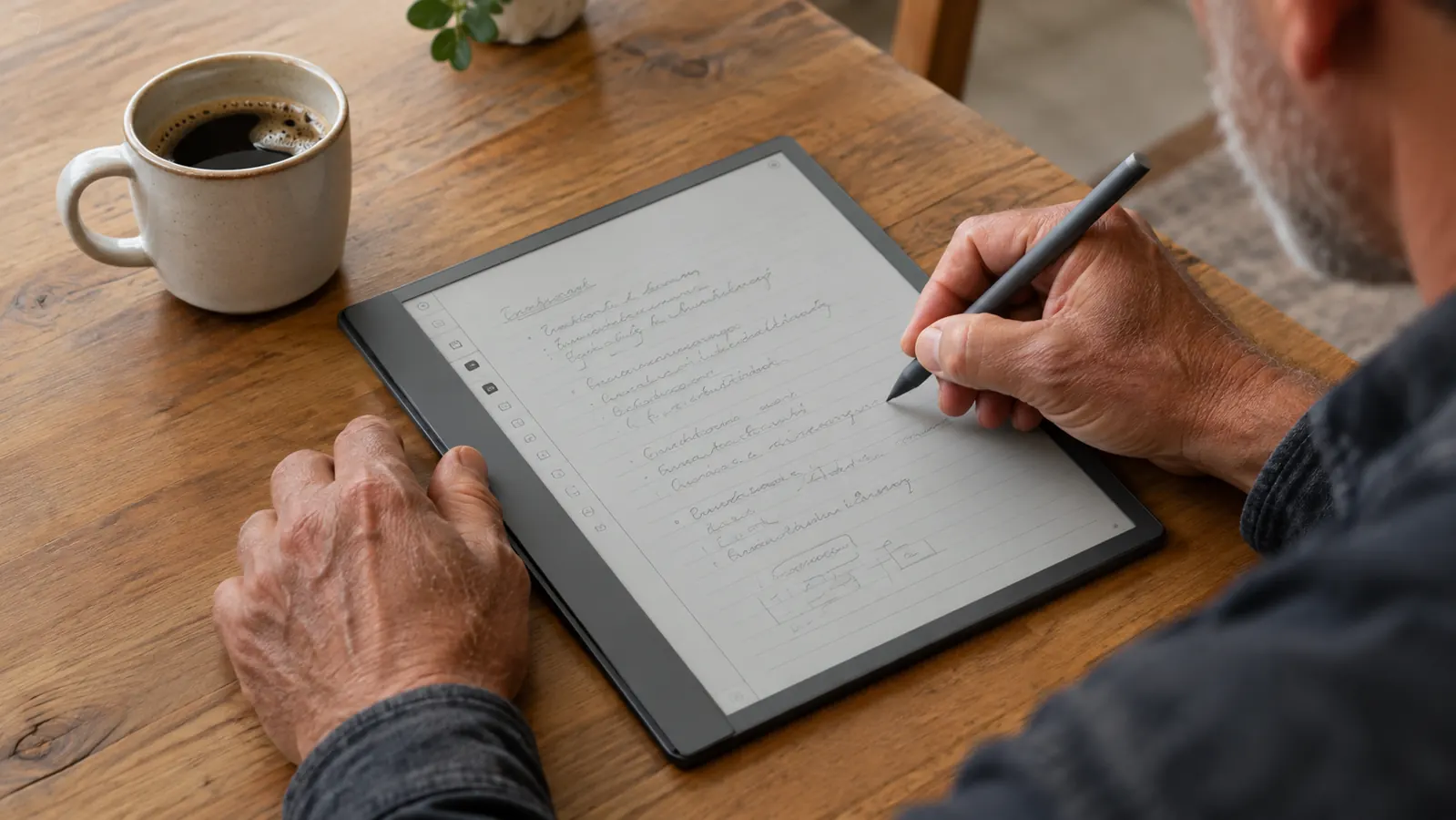
Here is the honest heart of this review. I am a lifelong margin writer. I underline, I circle, I argue with the author in the white space. For years I have read on e-readers and loved them, and I have also quietly missed the pencil. The Scribe fixes that in a way no other Kindle I have owned does. Amazon includes the Premium Pen in the box, and writing on the screen feels close enough to paper that I stopped noticing the difference by the end of the first chapter.
The note system takes a little getting used to. You do not write directly on the printed page the way you would with a real pencil. The Scribe uses sticky notes, which means a tap to open and a tap to close, and for the first week I found that fussy. Then it became automatic. Now I tap, write, close, and keep reading. The notes stay attached to the spot on the page, which is the part that matters.
What surprised me is how much this changed what I read. I read fiction on the Paperwhite, fast and happy. On the Scribe I read slower, because I am not just reading. I am talking back to the book. Four history books in five months does not sound like much for a person who reads two or three books a week. But those four books are the ones I actually remember. That is the trade, and it is a good one. I did not expect that. I expected a toy. What I got was a different way of reading.
The notebooks are the part I did not expect to love. I write my volunteer notes in the Scribe notebooks, and I have started keeping a reading journal in one, a page for each book with the passages I underlined. The Premium Pen has a comfortable weight, and I have learned to set it down in the same spot on the table every time, because a pen that small will walk off a cluttered surface if you let it.
The Honest Downsides Nobody Puts in the Ads
Now the part I promised you. First, the Scribe is not waterproof. My Paperwhite is, and I do not think about rain the same way with the Scribe. I keep it away from the kitchen sink and I do not carry it out to the porch if there is any chance of a shower. That is a real limitation, not a theoretical one.
Second, it is heavy. Not heavy like a tablet, but heavier than any Kindle I have owned. Reading a whole book on it in one sitting tires my arms in a way the Paperwhite never has. That is why it is a table device for me. If you want a reader you can hold over your head in bed, this is the wrong one. I do not take it to bed at all. The Paperwhite does that job.
Third, the note-taking on Kindle books is clunkier than a paper margin. It will never replace the feel of a real pencil on a real page, and I would not want it to. What it replaces is the pile of notebooks I used to keep. That is a fair trade for me. It might not be for you.
And then there is the price. I am not going to quote numbers, because they change. I will say this: the Scribe is not a small purchase, and it is worth it only if you actually write in it. If you do not, you have paid for a screen you will not use. That is the honest math, and it is the part of this review that matters most.
What I Liked
- Huge 10.2-inch e-ink screen makes long reading sessions genuinely easier on my eyes
- Premium Pen is included in the box, nothing extra to buy
- Margin notes on Kindle books work well once you learn the rhythm
- Notebooks replaced the paper notes I used to keep around the house
- Glare-free screen reads beautifully in bright daylight by the window
Where It Falls Short
- Not waterproof, so it stays away from water and weather
- Heavy enough that it is a two-hand or lap device, not a one-hand reader
- Note-taking on books is slower than a real pencil in a real margin
- Overkill if you only read fiction and never annotate
- I reach for it least often of all my readers, by design
How It Fits With the Rest of My Readers
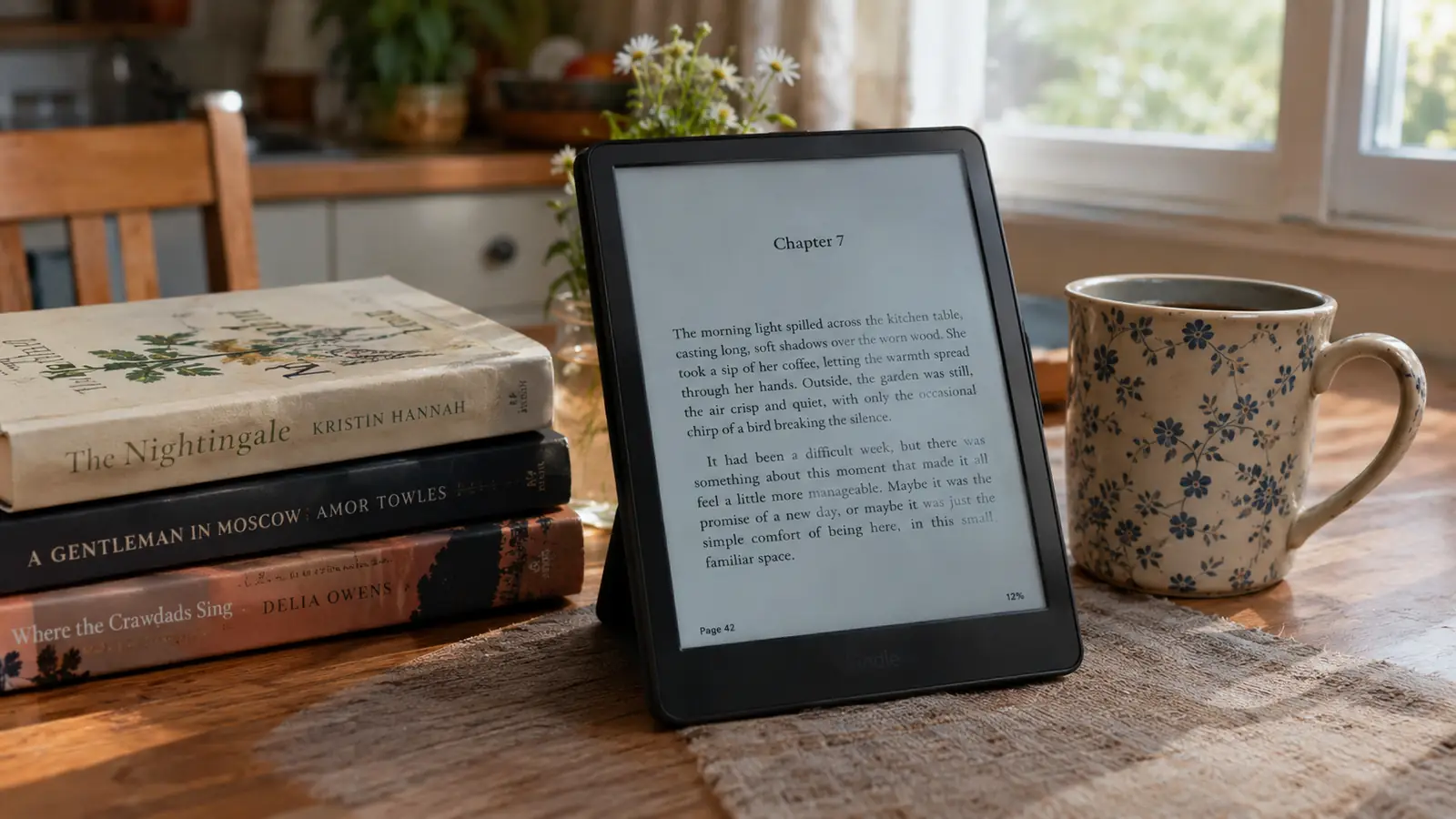
People ask why I own four readers, and the honest answer is that they do four different jobs. The Paperwhite is my bed book, every single night, with the warm light on. The Kobo is for bad-thumb days, because the page-turn buttons let me read without tapping. The Scribe is for the kitchen table and the books I want to argue with. And the tablet is for cookbooks and magazines, which need color and pictures. None of them is better than the others. They are just better at different things.
The Scribe does not replace any of them. That is the thing the marketing wants you to believe: that one device can do everything. In my house, it cannot. What it does is sit on the kitchen table and wait for the next book I actually want to think about. And because it is there, I read more slowly and remember more. For me, that is worth the space it takes up.
When I travel, the Scribe stays home. The Paperwhite goes in my bag, because it is lighter, smaller, and waterproof, and it does not mind being shoved next to a water bottle. The Scribe is a homebody device. It lives on the table, it gets carried from the kitchen to the armchair, and that is the whole of its traveling life.
That division of labor is the reason I have not regretted the purchase once. A device earns its place in my house by doing one job so well that I stop wishing it did another. The Scribe does that. It does not try to be my night reader, and I do not ask it to be.
Who This Is For
Buy the Scribe if you are a margin writer. If you underline sentences in books and feel guilty about it, if you keep a reading notebook, if you read history or biography or narrative nonfiction and find yourself talking back to the author, this is the first e-reader that treats that habit as the main event instead of an afterthought. It is also for anyone who wants one device to hold both their books and their handwritten notes. The notebooks alone replaced the paper system on my kitchen table.
It is for people who read at a table or in a lap chair, not for people who read hanging off the side of the bed. It is for people who want to slow down. If you have a shelf of books you loved and cannot remember a single sentence from, the Scribe will not fix your memory, but it will give you a place to keep the sentences that matter.
Who Should Skip It
Skip it if you read fiction in bed. Skip it if you want a one-handed reader. Skip it if you have never once written in a book margin, because the main reason to buy the Scribe is the writing, and if you do not write, you are carrying extra weight and a bigger screen for nothing. A smaller Kindle does the same job for noticeably less and fits in a bag. I love the Scribe. I also reach for it least. Both of those things are true, and both of them belong in an honest review.
And skip it if you are hoping the writing features will turn you into someone who takes notes. The Scribe makes margin writing easy, but it does not make it habitual. If a paper pencil never made you underline anything, a stylus will not either. Buy it for a habit you already have, not for a habit you wish you had.
That is the honest review in one paragraph. The Scribe is expensive, heavy, not waterproof, and not a bed reader. It is also the only device I own that has made me a more careful reader, and I have written more in five months than I wrote in five years of reading on screens. If that sounds like you, it is worth a look. If it does not, save the money and buy the smaller Kindle. Both answers are correct. And if you are still deciding, buy from a place with a good return policy, because only a few weeks of real use will tell you which kind of reader you are.
Buy the Scribe for the books you want to remember, not the ones you want to finish.
That is the most honest recommendation I can make after five months. If it sounds like your reading life, check today's price on Amazon.
Amazon Check Today's Price on Amazon →