

When I bought my Kindle Paperwhite last December, I ordered the CoBak case two days later, and it arrived the same week. I had handled a friend's Fintie trifold at the library's demo table a couple of weeks earlier, and I knew I wanted a stand case. My right thumb has bothered me for a couple of years now, mild arthritis that makes tapping a screen or holding a book open for an hour a genuine ache, so a case that props the Kindle up and lets my hands rest was not a luxury. It was the difference between reading for twenty minutes and reading for two hours. Ten months on, people still ask me which one to buy, so here is the honest comparison: the CoBak case versus the Fintie trifold, for protection and for propping.
The short answer: the CoBak case protects better and props more reliably on the surfaces where I actually read, which is a table, a tray, or a counter. The Fintie trifold is lighter in the hand and folds into more angles, but it never felt as secure to me, and its stand is fussier on a lap or a soft surface. If you read mostly at a table or counter, the CoBak is the one I would buy again. If you read mostly in hand, on the couch, with the Kindle in your palm and the cover folded back, the Fintie's lighter weight may serve you better. I will walk you through exactly why I landed where I did.
| CoBak stand case | Fintie trifold | |
|---|---|---|
| Protection | Faux leather cover that wakes and sleeps the Kindle, with a secure fold-over closure | Faux leather cover that wakes and sleeps the Kindle, with a magnetic closure |
| Stand | Folds back into one fixed stand angle, solid on a table, tray or counter | Folds into several viewing angles, but tips more easily on soft surfaces |
| Weight in hand | A bit more heft, which I notice on long reading sessions | Noticeably lighter, easier to hold one-handed |
| Drop protection | Survived one drop off the kitchen counter onto tile, no damage | I only handled it briefly, so I cannot vouch for a drop |
| Best for | Readers who prop the Kindle on a table, tray or counter | Readers who hold the Kindle in hand and want more viewing angles |
Where the CoBak Wins
The CoBak case wins on the two things I care about most: protection and a stand that stays put. The cover wakes the Kindle when I open it and puts it to sleep when I close it, which sounds small until you have lived without it. My old basic Kindle from 2015 had a plain cover with no sleep function, and I cannot tell you how many times I set it down, forgot to switch it off, and came back to a drained battery. The CoBak has never once left me with a dead Kindle, because closing the cover does the job for me. The fold-over closure keeps the cover shut in my canvas tote, and the faux leather has held up to ten months of daily use, including one drop off the kitchen counter onto tile. The Kindle came out of that drop with no damage, and the case barely showed it. I checked the corner again that evening, and the scuff was still there, a faint mark maybe the size of a fingernail. It has not grown in the months since.
The stand is the real reason I chose the CoBak. It folds back into one fixed angle, and that angle is exactly right for reading at the kitchen counter while I wait for water to boil, or on the tray table in the armchair. The angle sits somewhere around the middle of what a trifold offers, and after ten months I have stopped thinking about it entirely, which is the highest compliment I can pay a piece of reading gear. It does not wobble, it does not slowly slump, and it does not tip over when I turn a page. On a hard, flat surface, it is simply reliable. On the back porch in summer, I set it on the little side table next to my chair, and it holds the same steady angle there as it does in the kitchen. On a pillow or a blanket it will tip, and I knew that from the first week, so I simply do not prop it there. I hold it in bed instead, and the case is slim enough that holding it one-handed for a chapter or two is comfortable.
Let me give you a concrete example. On a Tuesday in late January, I had a pot of soup simmering and a new mystery novel waiting. I folded the CoBak cover back, set the Kindle on the counter beside the cutting board, and read for twenty minutes while the onions browned. I did not have to hold the Kindle, I did not have to adjust the angle, and I did not have to worry about it sliding. When the timer went off, I reached over, stirred the pot, and went right back to the page. The book was a library loan, and I remember thinking that the case was doing what a good reading tool should do: stay out of the way. That is the whole case in one scene: it disappears, and the reading takes over.
There was one drop. I had the Kindle on the kitchen counter, too close to the edge, and it slid off. It fell to the tile floor with a sound I do not want to repeat. I picked it up, opened the cover, and the screen was fine. The case had a small scuff on the corner that I only noticed because I went looking for it. Dale heard the noise from the other room and came in to see what broke, and when I held up the Kindle he just shook his head. That is the protection test that matters, and the CoBak passed it. I cannot promise every drop will end that way, and I would not recommend testing it on purpose, but I can tell you what happened when mine hit the floor.
The stand case that has held up through ten months of daily reading
If you read at a table, tray, or counter, the CoBak case gives you a solid stand and solid protection. It is the case I have used every day since December.
Amazon Check Today's Price on Amazon →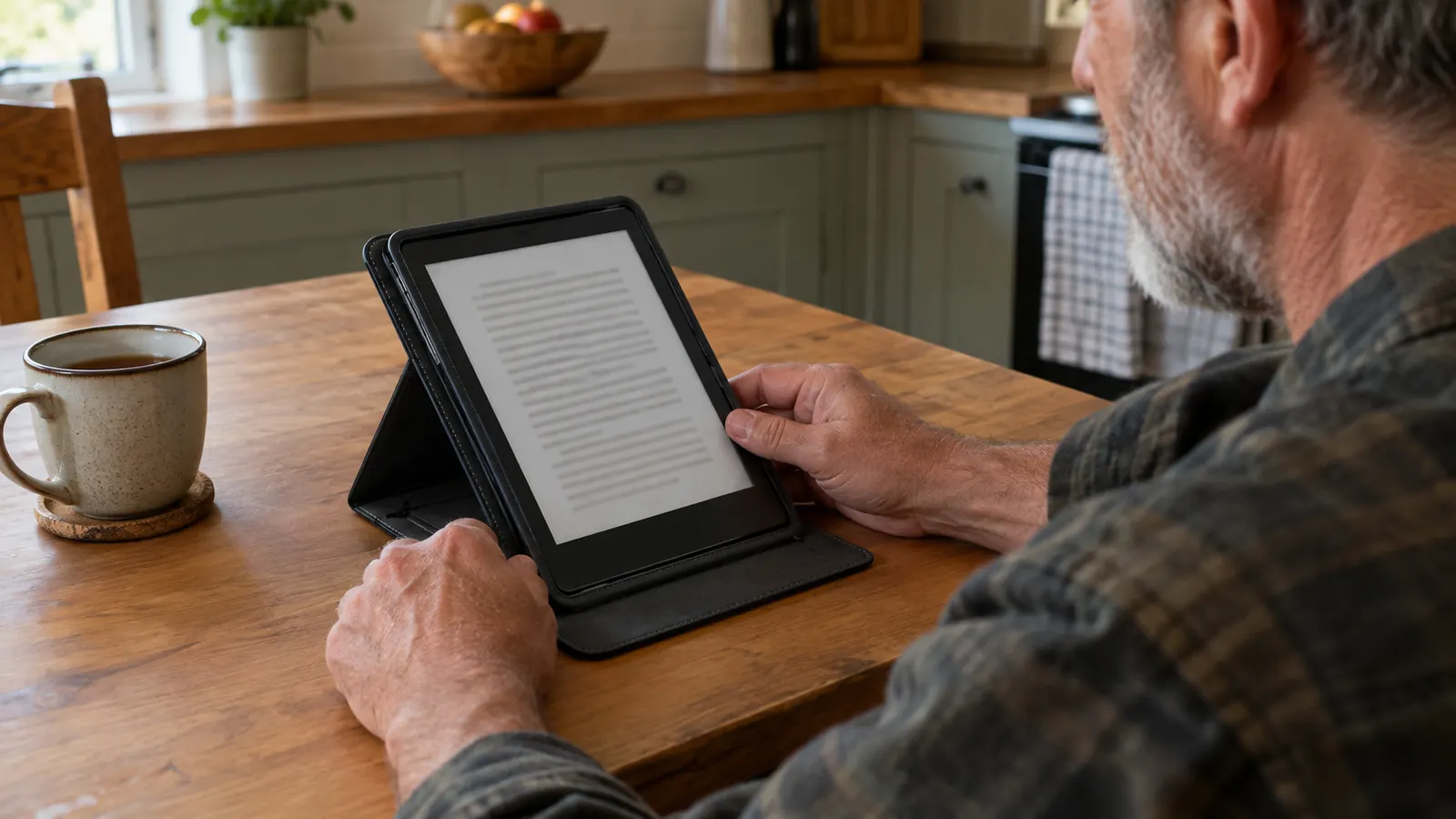
Where the Fintie Trifold Wins
I have to be fair to the Fintie. I only handled a friend's trifold for an afternoon in early December, so I cannot give it the same long-term verdict, but I can tell you what it does better. It is noticeably lighter in the hand, which matters if you hold your Kindle for an hour at a stretch. With my thumb the way it is, I notice weight quickly, and the Fintie was easier to hold one-handed than the CoBak, no question. And because the trifold cover folds into several angles, you can prop the Kindle lower or higher depending on whether you are at a table or on a couch. On a low coffee table you can fold it to a shallower angle; on a kitchen counter you can fold it steeper. That flexibility is real, and it is the Fintie's best argument.
The Fintie also feels a little softer in the hand, and the magnetic closure is convenient. For a reader who mostly holds the Kindle and only occasionally props it, the lighter weight and extra angles are a real advantage. I can see why so many people love it. It just was not the right trade for me, because when I am at a counter or a table I prop it, and the CoBak's single angle is the one I want anyway. Most of my daytime reading happens at a surface: the kitchen counter in the afternoon and the tray table in the armchair. In bed at night I just hold it. When I hold the Kindle in bed before I fall asleep, the CoBak's weight has never bothered me. The afternoon I tried it, I read a chapter of a mystery at the demo table just to feel the weight, and I could see the appeal immediately.
Here is the afternoon I spent with the Fintie, so you can judge for yourself. My friend brought it to the library's demo table in early December, and I tried it on three surfaces: the table, my lap, and the arm of the couch. On the table it propped fine at the middle angle, and I will say the lower angle was nice for a change of posture. On my lap it wanted to tip backward whenever I reached to turn a page, and I caught it twice before it went over. On the couch arm it balanced only if I positioned it just so, with the seam of the fold lined up exactly with the edge of the cushion. The extra angles are real, but each one needs a surface that cooperates, and the surfaces in my house do not always cooperate.
I also noticed the Fintie's magnetic closure. It is convenient, no question, and it snaps shut with a satisfying feel. But I keep my Kindle in a canvas tote with library books and a water bottle, and I like that the CoBak's fold-over flap does not depend on a magnet holding against whatever else is in the bag. I have had magnetic closures on other things fail when a book pressed against the cover from the inside, and once a flap pops open in a bag, the screen is exposed to whatever else is in there. That is a small thing, but it is the kind of small thing that decides whether a case works for your actual life.

Who Should Buy Which
Buy the CoBak case if you read at a table, a tray, or a counter, if you want a case that stays shut in a bag, and if you would rather have one rock-solid stand angle than three wobbly ones. That is me: I read at the kitchen counter and on the tray table in the armchair, and I hold it in bed at night, and the CoBak has never let me down in any of those places. It is also the right choice if you carry your Kindle in a bag with other things, because the fold-over closure does not rely on a magnet to stay shut. And it is the right choice if you have hands that ache, because a case that props the Kindle at the right angle means your hands can rest. At night, after I turn out the lamp, the Kindle goes back in its case on the bedside table, and the fold-over flap means I do not have to check whether it stayed closed.
Buy the Fintie trifold if you mostly hold your Kindle in hand, if you want more viewing angles, and if lighter weight matters more to you than a sturdier stand. It is a good case, and for a lot of readers it is the right one. If you read curled up on the couch with the Kindle in your palm, the Fintie's lighter weight will serve you better than the CoBak's extra heft. But for protection and propping on the surfaces where I actually read, the CoBak is the case I would buy again, and the one I would recommend to a friend.
One more note on the CoBak, because it is the detail that surprised me most. The single stand angle is not a limitation, it is a feature. I never find myself wishing for a lower angle or a higher one, because the angle the CoBak gives me is the angle I would choose anyway. It is the difference between a tool that does one job perfectly and a tool that does three jobs adequately. For reading, I want the one job done perfectly. The Fintie gives you choices, and choices are wonderful until you are holding a book in one hand and a mug of tea in the other, trying to find the one angle that will not slide. The CoBak takes that decision away from me, and I did not realize how much I would appreciate that until I lived with it. And on the mornings when I carry it to the kitchen with my tea, it is the same case, the same angle, the same reliable prop.
The CoBak case is the one I have used every day for ten months
Solid stand, solid protection, and a cover that wakes and sleeps the Kindle. If that sounds like your reading style, it is worth a look.
Amazon Check Today's Price on Amazon →