

I have a confession that will not surprise anyone who has spent an evening reading with a bare e-reader: my hands get tired. Not the dramatic kind of tired. The quiet kind, where you notice you have been gripping the device for an hour and your right thumb is asking for a break. Mild arthritis in that thumb means I notice sooner than most. The fix turned out to be embarrassingly simple. A CoBak stand case for my Kindle Paperwhite. It took about one evening to get used to, and it has not left the reader since. The cover folds back into a stand, the reader sits at a comfortable angle, and my hands finally get to do what they are meant for: holding a book open in spirit, not holding a device aloft.
This list is the ten reasons I keep reaching for that case, in the order they matter to me. If your hands ache after a long reading session, or you read in bed, in an armchair, or at the kitchen table, these are the ones that will make sense to you. No single reason is a big deal. Together, they change how a reading evening feels. Reading is the hobby I protect most, and I have learned that comfort is what keeps me in the chair. A device that is a pleasure to hold gets used. A device that is not, ends up on a charger.
A case that does the holding for you
The CoBak stand case props your Kindle at a comfortable angle on any flat surface, wakes it when you open the cover, and gives your hands a real break. It is the first accessory I recommend to anyone whose hands get tired after an evening of reading.
Amazon Check Today's Price on Amazon →Ten Reasons the Stand Earns Its Place
Your second hand gets the night off.
When a reader stands on its own, you do not need one hand to hold it and one hand to turn pages. You need one hand, and sometimes none. I read on the back porch in summer with a glass of iced tea in the other hand, and I turn pages when I feel like it. For someone with a cranky right thumb, that is not a small thing. It is the difference between reading for an hour and reading for an evening. That is the quiet win of a stand: it turns an evening alone into something my hands barely have to think about.

Your wrist stays straight instead of bent.
Holding a bare reader, you angle your wrist to keep the screen facing you. After a chapter or two, that angle starts to complain. On a table, the CoBak case holds the reader at one fixed angle, so my wrist stays in a neutral line. I noticed the change within the first week, mostly because I stopped shaking my hand out between chapters. That is the kind of improvement you do not notice until it is gone.
You can finally relax your grip.
I did not realize how hard I was gripping my old Kindle until I did not have to. A bare reader collects a death grip without you noticing. With the case propped on a table or tray, the device does the holding. My fingers rest. My palm rests. By the end of a long book, my hand feels like I spent the evening doing nothing, which is exactly the point of reading.
Any flat surface becomes a reading spot.
The stand works on a table, a tray, or a counter. That means the side table next to my blue armchair, the porch table in summer, and the edge of the kitchen counter while I wait for the kettle. I do not have to hunt for the perfect position. I set the reader down, and it stands. For someone who reads in three different places on a normal day, that flexibility is what makes the case earn its keep.
Page turns get kinder to a sore thumb.
When a reader is propped upright, you can tap the screen with whatever finger is comfortable, or the side of your hand, or your knuckle. You are not holding the device, so the tap does not need to be a careful balancing act. On the days my thumb is only a little stiff, I turn pages with my left hand; on truly bad days I switch to my reader with page-turn buttons. On good days, I use my right. The case does not care. That flexibility matters more than I expected.
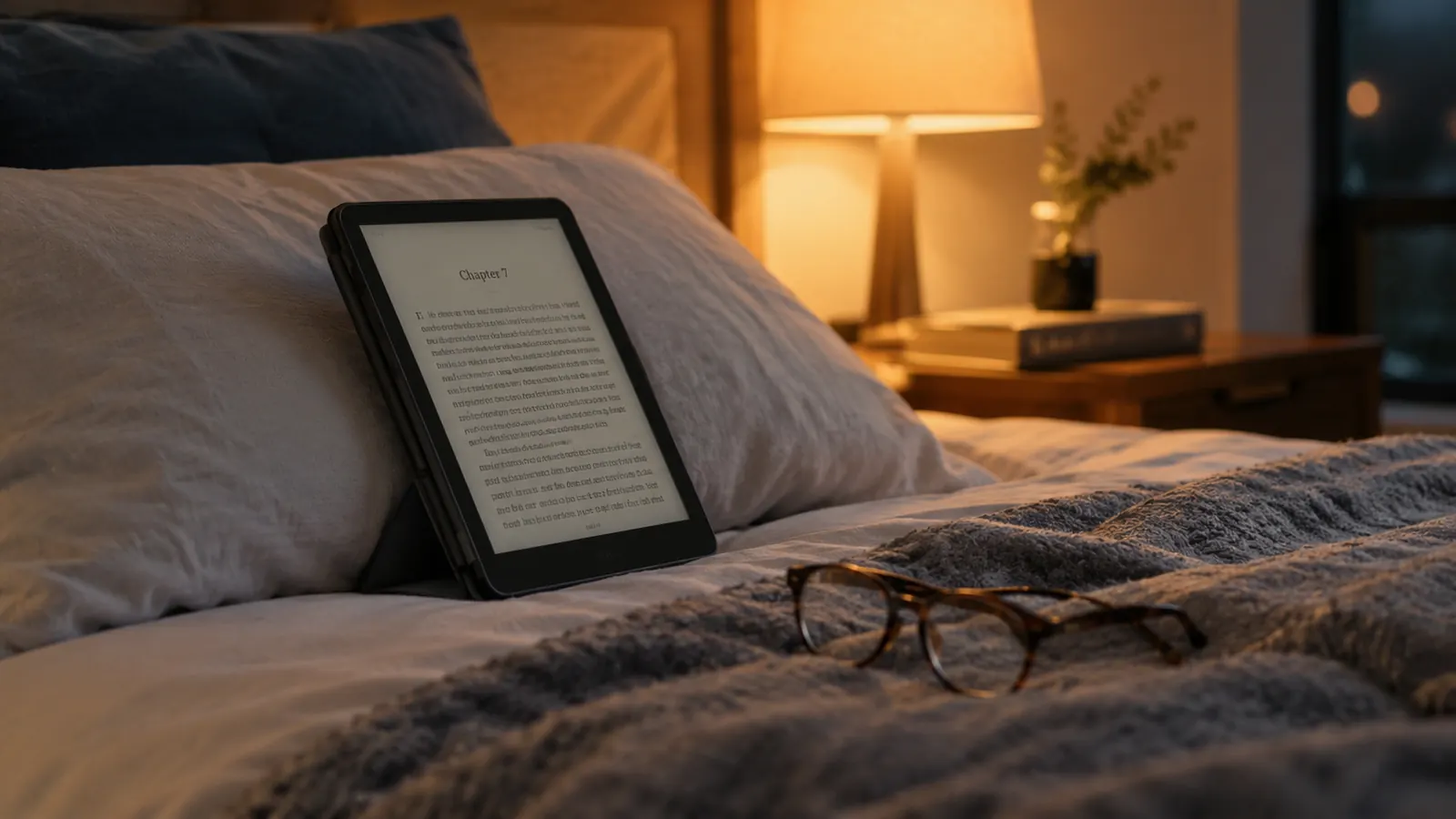
The screen comes up to eye level.
A reader lying flat on a table asks you to look down, and looking down for two hours asks your neck to do the work. Propped in the stand, the screen sits closer to eye level, so my head stays in a comfortable position. I wear reading glasses, and the difference in how quickly my eyes settle is noticeable. Less hunching, less squinting, less of that stiff-neck feeling at the end of a chapter. I notice it most on days when I have been reading for a few hours straight.
No more hunting for the power button.
The CoBak cover wakes the Kindle when you open it and puts it to sleep when you close it. That sounds like a small convenience, but it is the kind you feel dozens of times a day. You do not fumble for the button, you do not tap the screen to see if it is on, you just open the cover and start reading. For tired hands, fewer fumbles is a real benefit.
It takes the fall so the Kindle does not.
The case has already earned its keep once, in a way I would rather not repeat. My Paperwhite slid off the kitchen counter onto the tile floor, still inside the CoBak case. The tile was unforgiving, and I braced for the worst when I picked it up. The case took the hit. The reader came out without a scratch. I cannot promise yours will survive every drop, but I can tell you mine did, and that one moment was worth the whole thing on its own.
The screen stays steady while you tap.
When you hold a bare reader and tap the screen, the device moves a little with each tap. You adjust your grip, it moves again, and after a while you are constantly resettling. Propped in the stand, the reader stays put. Every tap lands the same way. It sounds small, but steady is restful. My reading sessions got noticeably calmer once I stopped chasing the screen around.
It folds back when you want to hold it close.
The stand is not the whole story. When I read in bed, I hold the Paperwhite, and the folded-back cover gives me a little more to hold onto. The case does not force you to choose between standing and holding. It does both, depending on the moment. That is why it stays on the reader instead of living in a drawer.
What I'd Skip
The stand is not for everyone. It tips over on soft surfaces. Pillows, blankets, a lap, all of them will defeat it. I read in bed every night, and I do not use the stand there. I hold the reader, which is why the last reason on this list matters to me. If you were hoping to prop the reader on a pillow beside you, this stand will not do that. It wants a firm, flat surface, and it offers one fixed angle, not a range of positions. If you never read at a table, the stand is a feature you will not use, and you might be happier with a plain cover.
When the Paperwhite slid off the kitchen counter onto tile, the CoBak case took the hit and the screen came through without a scratch.
None of these reasons is dramatic on its own. Together they add up to something real: reading sessions that end because the book is finished, not because my hands gave out. That is the whole argument for the case, and it is why mine has not left the reader in ten months.
Give your hands the night off
If your hands ache after long reading sessions, a stand case is the smallest fix that actually works. The CoBak case holds the reader steady at a comfortable angle, wakes it when you open the cover, and has already survived one drop in my house.
Amazon Check Today's Price on Amazon →