

When you buy a Kindle Paperwhite, the case feels like the afterthought on the checkout page. You have already deliberated over storage, the warm light, and whether you really need waterproofing. The case is the thing you add so the device does not get scratched in your bag. I ordered my CoBak case two days after the Paperwhite itself, mostly out of habit, and I did not expect to have an opinion about it ten months later. I do, though. It turns out the case is the difference between a reader that lives in your hand and one that lives in a drawer.
I have been reading two or three books a week for as long as I can remember, and I treat reading gear the way a carpenter treats tools. It has to work, it has to hold up, and it should get out of the way while you do the actual job. That is the standard I have held the CoBak case to since December, and it is why this review is not really about a piece of plastic and faux leather. It is about whether an accessory earns its place on a device you reach for every single night.
The Quick Verdict
The CoBak case is the rare accessory that disappears while you read and proves its worth the one time you drop the device. Ten months of nightly use, one fall onto tile, and the cover still wakes the Kindle every single time.
Amazon Check Today's Price →The Case That Has Stayed on My Paperwhite for Ten Months
If you just bought a Paperwhite and want a case that wakes the screen, folds into a stand, and holds up to daily use, this is the one I have used every night since December.
Amazon Check Today's Price on Amazon →How I've Used It
The Paperwhite arrived in mid-December of last year, and the CoBak case arrived two days later. I ordered the case before I had finished setting up the Kindle, which tells you how little I thought about it. I just wanted something on the device before it went anywhere. Ten months later, the case has not come off once. It does not need to. That is the first thing to understand about it: you put it on and forget it is there, the way you forget a good pair of shoes. The second thing is that forgetting it is there is exactly the point. A case that makes you think about the case is a case that has failed.
My reading life has a rhythm. The Paperwhite is in bed with me every night, it sits in the armchair by the living-room window on normal days, and it rides out to the back porch in summer. The CoBak case is part of all three. The cover wakes the Kindle when I open it and puts it to sleep when I close it, which sounds like a small thing until you have lived with a case that does not do it and you find yourself jabbing the power button with a tired thumb. On a normal night I open the cover, the screen lights up, and I am reading before my glasses are settled.
I should also say what I use it for that is not glamorous. The case has sat on a breakfast tray, on the kitchen counter while I looked up a recipe, and on the table at the Friends of the Library book sale while I waited for my volunteer shift to start. It works on any of those. The stand folds back at one fixed angle, and that angle happens to be right for all of them. I have also carried the Kindle loose in a tote more times than I can count, and the case is the reason I do not worry about what else is in there with it.

What the CoBak Case Actually Does
Strip away the marketing and the case does three things. It protects the Paperwhite, it wakes and sleeps the screen when you open and close the cover, and it folds into a stand. That is the whole list, and I mean that as a compliment. The cases that try to do more usually do less of the basics. A case that adds a kickstand, a strap, a pocket, and a pen loop ends up thick enough that you notice it in your hand on page two. This one stays out of the way, which is exactly what a case for a reading device should do.
The fit is snug around the 7-inch Paperwhite, and the same case fits the Colorsoft, which matters if you ever upgrade. The device clicks in and stays put; I have never had it shift inside the case, even after the drop. The faux leather cover has held up without peeling or cracking at the corners, which is where cheap cases always fail first. Ten months in, the edges still line up and the openings still match the charging port and the power button. Nothing has stretched, nothing has loosened.
The thing I notice most is what I do not notice. The cover folds back flat against the back panel, so the Paperwhite still feels like a Paperwhite in your hand, not like a book wrapped in a brick. For someone who reads for an hour or more at a stretch, that matters. A bulky case makes you put the reader down sooner. This one does not. I read for two hours most nights, and the case has never once made me shift position or switch hands to rest my wrist.
The power button and the charging port are exactly where they should be. That sounds like faint praise, but I have used cases where the openings were a fraction of an inch off, and you spend the rest of your ownership wiggling the charging cable and hunting for the button by feel. The CoBak case gets this right, and it is the kind of detail that only shows up over time.
The Stand: One Angle, and That's Enough
The stand is the feature I was most skeptical about and the one I use most. Fold the cover back and it props the Kindle at a fixed angle. On the breakfast tray, on the kitchen counter, on the table, it holds steady. I have read entire chapters with the device propped while I ate breakfast, and I have followed recipes with both hands free. When my right thumb is a little stiff, propping the Kindle means I can turn pages with my left hand without holding the device at all.
The honest limitation is that the stand wants a firm surface. On a pillow, on a blanket, on a lap, it tips over. The angle is fixed, so you cannot tilt the screen to chase the light or cut a glare. I learned both things in the first week and adjusted. If you read only in bed with the Kindle flat on the mattress, the stand will not change your life. If you read at a table or a counter, it will. Most of my daytime reading happens at a table of some kind, which is why the stand earns its keep.
The Drop I Didn't Plan
Once, I did something I do not recommend. I set the Paperwhite on the kitchen counter too close to the edge, and it slid off and hit the tile floor. The sound was terrible, the kind of crack that makes you close your eyes before you look. I braced for a cracked screen and a dead spot where I would have to tap three times to turn a page. I have seen what a fall does to an unprotected reader, and it is the end of the device for practical purposes.
The case took the impact. The Paperwhite was fine, no damage, and the case showed a scuff I could rub off with a thumb. I have been carrying the same case ever since. That is the moment a case stops being an accessory and starts being insurance, and it is the reason I would buy the same one again without hesitation. You cannot plan a drop, but you can plan for one.
Ten months in, after one drop onto tile, the cover still wakes the Kindle every time and the case still fits like the day I put it on.
The Night Test
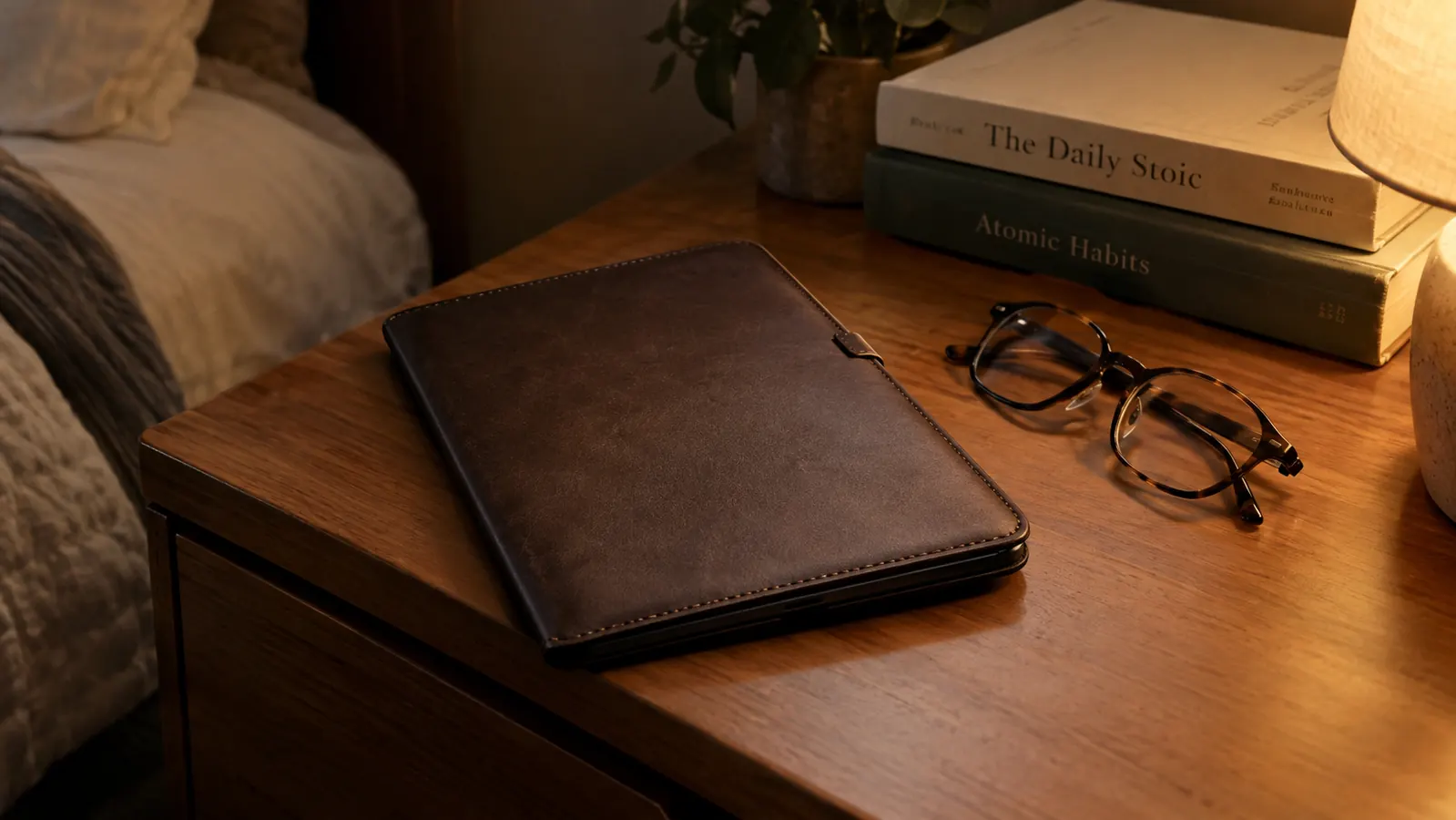
Most of my reading happens after dark, in bed, with the warm light turned up and my reading glasses on. That is the test the case has passed every night for ten months. The cover opens flat and stays out of the way while I hold the Kindle in one hand. When I finish a chapter and set the device on the nightstand, I close the cover and the screen goes dark. In the morning I open it and the Kindle is right where I left it, on the page, waiting.
I do not use dark mode. The warm light on the Paperwhite is enough for my eyes, and the case does not get in the way of it at all. The cover folds back to a slim flap that rests against the back panel, so there is nothing flopping around while I read one-handed. That is the kind of detail you only notice by its absence, the way you only notice a good hinge when it stops working.
The only adjustment I made was early on, when I kept trying to fold the cover past the stand angle to get the screen closer to my face. The hinge stops at the stand position, and after a few nights I stopped trying. Now in bed I read with the cover folded flat behind the Kindle, and it works.
Ten Months In
The cover still wakes the Kindle every time I open it, which I did not expect. Every case I have owned before this one eventually got lazy about that, and you learn to live with a case that sometimes leaves the screen dark and sometimes wakes it when you barely touch it. The CoBak has not done that once. Ten months, seven nights a week, and the wake and sleep cycle has been as dependable as the page turn.
The faux leather has worn honestly. There is no peeling at the corners, no cracking along the spine, no fraying at the edges. The case looks like what it is: something used daily for the better part of a year. That is the right look for a tool. I would rather have a case that shows honest wear than one that stays pristine because it spends its life in a drawer.
The one thing I would change is the fixed angle, and even that I have made my peace with. A second angle would be nice for reading on a higher table, but it would also make the hinge bulkier. Given the choice between a case that disappears in the hand and one with more angles, I would take the one that disappears. Most days I do not think about the case at all, and that is the highest compliment I can pay it. A case you notice is a case doing its job badly.
What I Liked
- Cover wakes and sleeps the Kindle reliably, ten months in
- Folds into a stand that holds steady on tables, trays, and counters
- Snug fit around the 7-inch Paperwhite, and the same case fits the Colorsoft
- Faux leather has not peeled or cracked at the corners
- Survived a real drop from counter height onto tile with no damage to the Kindle
Where It Falls Short
- Stand works at one fixed angle only
- Tips over on pillows, blankets, and laps
- Adds a little bulk if you are used to reading a bare Kindle
Who This Is For
Buy the CoBak case if you read in more than one place. It is for the person who takes the Paperwhite from the bed to the armchair to the porch and wants one case that works in all of them. It is for the person who reads at the kitchen table with both hands free, who follows a recipe from a propped screen, who wants the device protected without thinking about the protection. If you just bought a Paperwhite and you are choosing between a bare reader and a case, get the case. You will drop the device eventually. Everyone does. The question is whether you are holding a case when it happens.
Who Should Skip It
Skip the CoBak case if you read lying down with the Kindle propped on a pillow, because the stand will not stay put there. Skip it if you are hoping a case will give the Paperwhite physical page-turn buttons; it cannot, and if that is what your hands need, the answer is a different reader, not a different case. And if you want a case with multiple stand angles or a built-in hand strap, this one is deliberately simple, and the simplicity is the point. The same design choices that make it unobtrusive are the ones that make it less flexible. For everyone else, it has been the right case for ten months, and I do not see that changing.
The Case I'd Buy Again Without Hesitation
After ten months of nightly use and one real drop, the CoBak case is still doing its job. If you want the same protection for your Paperwhite, check today's price on Amazon.
Amazon Check Today's Price on Amazon →